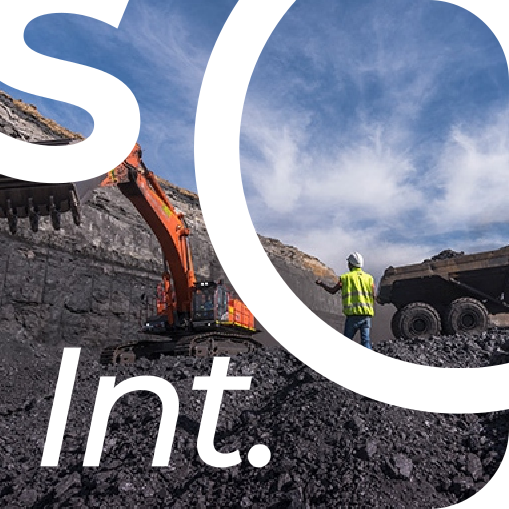
Our portfolio spans strategic and precious minerals sourced responsibly and delivered with reliability.
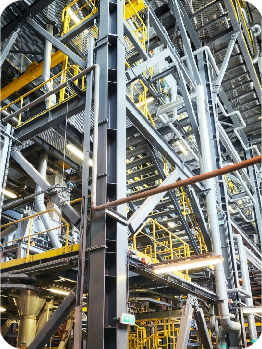
Iron Ore - Steelmaking Backbone
Primary raw material for steelmaking.
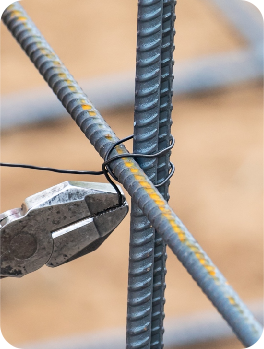
Iron ore is the world’s primary raw material for steel production, making it one of the most traded commodities. Steel is the backbone of modern infrastructure, transport, and industry.
Different ore types (pellets, fines, lump ore) suit various furnace needs.
Market Context: Demand follows global steel output, especially in
Asia’s urbanization projects.
Uses: Construction, automotive, shipbuilding, and heavy manufacturing. Benefits: Strength, versatility, and recyclability. Fun Fact: Over 98% of mined iron ore goes directly into steel the most recycled material on Earth
Chrome -Stainless Steel Ingredient
Metallic ore rich in chromium.
Chromite ore is enriched into chrome concentrate or traded as raw ore, forming a crucial ingredient in the production of ferrochrome, which is blended into stainless steel.
Chrome improves strength, corrosion resistance, and heat tolerance, making it invaluable in industries like construction, automotive, and aerospace.
Market Context: Asia dominates chrome demand, with stainless steel production being the key driver.
Supply often flactuates due to mining regulations, creating opportunities for reliable brokers.
Uses: Core ingredient in stainless steel and alloys, also used in refractory and chemical industries. Benefits: Adds corrosion resistance, strength, and durability to steel and industrial products. Fun Fact: Without chrome, there would be no stainless steel cutlery on your dinner table.
Gold -Universal Store of Value
Precious metal in bullion and dore form.
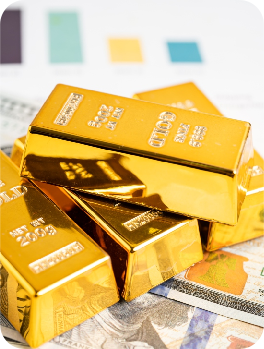
Gold has been valued for centuries as both a luxury material and a store of wealth. It is traded globally as bullion, coins, or dore bars, and used in jewelry, electronics, and even medical devices due to its conductivity and anti-corrosive properties.
Its enduring appeal lies in wealth preservation and safe-haven investment, especially during economic uncertainty
Market Context: Prices move with inflation, central bank activity, and global uncertainty.
Uses: Investment bullion, jewelry, central bank reserves, and electronics. Benefits: Universally valued, highly liquid, and a stable store of wealth. Fun Fact: All the gold ever mined could fit into a cube just 23 meters on each side.
Platinum-Catalyst for Innovation
Rare, dense precious metal.
Platinum is rarer than gold and known for its dense, durable, and catalytic properties. It is heavily used in automotive catalytic converters to reduce emissions, in jewelry for its elegance, and increasingly in fuel cell technologies.
Its dual role as a luxury metal and an industrial catalyst makes it highly valuable.
Market Context: The platinum market is shaped by stricter environmental regulations and the shift towards hydrogen energy, ensuring long-term demand.
Uses: Automotive catalytic converters, jewelry, fuel cells. Benefits: Universally valued, highly liquid, and a stable store of wealth. Fun Fact: Platinum is about 30 times rarer than gold in Earth’s crust.
Lithium -Battery Revolution Mineral
Lightweight alkali metal.
Lithium is the lightest metal and forms the core of rechargeable lithium-ion batteries that power electric vehicles, renewable energy storage systems, and consumer electronics.
Its ability to hold high energy density makes it critical to the energy transition.
Market Context: Demand is accelerating due to the EV boom and global net-zero commitments , with governments securing long-term lithium supply chains as a strategic priority.
Uses: Batteries for electric vehicles, energy storage, and portable electronics. Benefits: Powers the global clean-energy transition; lightweight and rechargeable. Fun Fact: Platinum is about 30 times rarer than gold in Earth’s crust.
Cobalt -Battery Performance Enhancer / Stabilizer
Hard, silver-grey metal often mined with copper/nickel.
Cobalt is a metallic element often mined alongside copper and nickel. It plays a vital role in stabilizing lithium-ion batteries, extending lifespan and improving safety.
Beyond energy storage, it is used in superalloys, magnets, and aerospace components.
Market Context:With EVs driving battery demand, cobalt supply is under constant watch due to its concentration in Central Africa, making secure brokerage and sourcing highly valuable.
Uses: Rechargeable batteries, aerospace alloys, and medical equipment. Benefits: Increases battery energy density, critical for EVs and renewable energy storage. Fun Fact: The word “cobalt” comes from “kobold,” a German word for “goblin,” because miners once thought it cursed their silver ores.
Copper -Conductor of Modern Life
Highly conductive industrial metal.
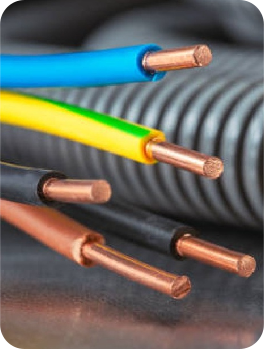
Copper’s excellent electrical conductivity makes it indispensable in wiring, power grids, renewable energy systems, and electronics. It is also widely used in construction, plumbing, and machinery. Its recyclability adds to its value in sustainable industries.
Market Context: Demand is soaring as the world shifts to electrification, with renewable energy, smart grids and EVs driving record consumption.
Nickel is prized for its resistance to corrosion and its role in creating stainless steel, which accounts for most of its use.
Recently, demand has grown rapidly in the EV battery industry, where nickel-rich cathodes improve energy density.
Market Context: With two strong markets — stainless steel and batteries, nickel demand is resilient and increasingly tied to the green economy.
Uses: Stainless steel, alloys, and rechargeable batteries. Benefits: Adds durability and corrosion resistance, boosts battery performance. Fun Fact: Some of the world’s largest nickel deposits actually come from ancient volcanic eruptions.
Bauxite - Aluminium Feedstock
Primary ore of aluminium.
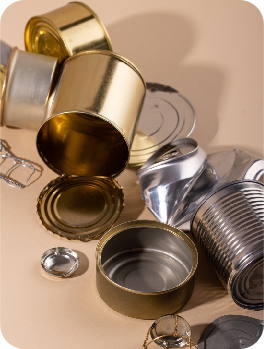
Bauxite is the primary ore for producing aluminium, a metal known for being lightweight, strong, and recyclable. Aluminium is essential in packaging, construction, aviation, and transportation, where reducing weight improves fuel efficiency.
Market Context: Global demand for bauxite is tied to the rapid growth in aluminium use, particularly in Asia’s manufacturing and infrastructure industries.
Uses: Aluminium production, refractories, abrasives. Benefits: Lightweight, strong, corrosion-resistant end-use. Fun Fact: Recycling aluminium saves up to 95% of the energy needed to make it from bauxite.
Manganese -Steel Strengthener
Grey-white metal used mainly in alloys.
Manganese is essential in steelmaking, where it acts as a strengthener and deoxidizer, improving toughness and wear resistance.
It is also used in fertilizers and as a component in some EV batteries.
Market Context: Its role in steel ensures steady demand, while the energy
transition creates new opportunities through its use in battery technologies
Uses: Steelmaking, batteries, fertilizers. Benefits: Improves strength and durability of steel. Fun Fact: Without manganese, steel would be too brittle to build skyscrapers.
Graphite - Carbon Powerhouse
Natural form of crystalline carbon.
Graphite is a naturally occurring form of crystalline carbon, known for its conductivity and stability at high temperatures. It is widely used in lithium-ion batteries, lubricants, refractories, and steelmaking electrodes.
Market Context: Battery demand is making graphite a “critical mineral,” with
demand projected to grow faster than supply due to Ev and renewable energy industries.
Uses: Lithium-ion batteries, refractories, lubricants. Benefits: Conductivity, heat resistance, high stability. Fun Fact: The “lead” in pencils is actually graphite, not lead at all.
Titanium - Lightweight Strength
Strong, corrosion-resistant metal.
Titanium combines lightweight properties with exceptional strength and corrosion resistance, making it essential in aerospace, defense, and medical implants. Titanium dioxide, derived from the mineral, is also a leading pigment in paints and plastics.
Market Context: Rising demand comes from the aerospace sector, medical implants, and the shift to lightweight transport materials.
Uses: Aerospace, medical implants, pigments. Benefits: High strength-to-weight ratio, biocompatibility. Fun Fact: Titanium is as strong as steel but 45% lighter.
Silver - Industrial Precious Metal
Strong, corrosion-resistant metal.
Silver is both a precious and industrial metal, known for its conductivity and antibacterial qualities. It is used in jewelry, electronics, solar panels, and medicine. Its dual nature means it is sought after in both investment and industrial sectors.
Market Context: Growth in solar power and 5G technology has created new industrial demands along traditional investment markets.
Uses: Electronics, solar panels, jewelry, medicine. Benefits: Dual role as industrial input and store of value. Fun Fact: Silver is the best conductor of electricity of all metals.
Zinc -Rust Protector
Base metal, often used in alloys.
Zinc is a base metal mainly used to galvanize steel, preventing corrosion in buildings, vehicles, and infrastructure. It is also used in alloys, fertilizers, and health products.
Market Context: Global construction drives zinc demand, while increased infrastructure investment ensures steady consumption growth.
Uses: Galvanizing steel, die-casting, fertilizers. Benefits: Prevents rust, essential for infrastructure. Fun Fact: Your body actually needs zinc — it’s essential for immune health.
Rare Earth Elements (REEs) - Technology enablers
Group of 17 elements with unique properties
This group of 17 elements has unique magnetic, phosphorescent, and catalytic properties. REEs are essential for wind turbines, EV motors, smartphones, defense technologies, and electronics.
Market Context: With supply heavily concentrated in a few countries, REEs are seen as strategic minerals vital for the clean energy transition and modern technologies
Uses: Magnets, EV motors, wind turbines, electronics. Benefits: High efficiency in green technologies Fun Fact: Your smartphone likely contains at least 9 different rare earth elements.